No products in the cart.
Return To Shop
Diabetes sensors: how continuous monitoring makes sugar control easier
Diabetes sensors today are changing how people with diabetes or prediabetes monitor their health daily. If you are looking for a way to monitor your glucose level without routine finger pricks, in this article you will find a detailed explanation of how continuous monitoring technology works, who it is suitable for, and what is worth paying attention to when choosing. You can also view our sold glucose sensors and find the most suitable option for yourself.
What are diabetes sensors and how do they work?

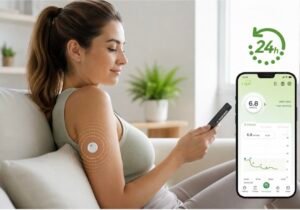
Diabetes sensors are continuous glucose monitoring (CGM) devices that measure the glucose level in interstitial fluid, rather than directly in the blood. The sensor — a thin, flexible filament — is gently inserted under the skin, usually on the upper arm or abdomen. It does not go deep: contact with the tissue is minimal, and the procedure takes just a few seconds.
The inserted sensor sends data to a smartphone via Bluetooth connection. This way you get up to 1,440 measurements per day — that is one measurement every minute. Instead of routine finger pricks several times a day, you see a glucose curve in real time on your phone screen: how it rises after a meal, how it drops at night or after physical exertion.
How do sensors differ from a traditional glucose monitor?
A traditional glucose monitor provides a single point measurement at the moment the test is performed. This is useful, but does not reveal the whole picture: how glucose changed over the last few hours, whether there were fluctuations at night, how a specific situation — stress, a meal, walking — affected the level.
Diabetes sensors fill this gap. A continuous curve allows you to:
- see glucose trends, not just a momentary value;
- notice fluctuations that you would not capture with routine finger pricks several times a day;
- better understand how food, sleep, or physical activity affects your sugar level;
- react in time — even before the reading exceeds a critical limit.
Important to know: CGM sensors do not replace a traditional glucose monitor and a consultation with a doctor — they complement it, providing a broader context.
Who is continuous glucose monitoring (CGM) best suited for?
Continuous monitoring is a useful tool for several groups:
- People with type 1 diabetes, whose glucose can change rapidly and it is important to notice hypoglycemia or hyperglycemia early.
- People with type 2 diabetes who want to better understand how their lifestyle affects their sugar level.
- People in the prediabetes stage who aim to monitor changes and follow a healthier lifestyle.
- Active people and athletes for whom physical exertion significantly changes glucose readings.
If you are not sure whether a sensor is suitable for you, consult a doctor or diabetologist — they will help evaluate how useful frequent monitoring is in your situation.
LinX CGM: minimally invasive sensor for up to 15 days
One of the CGM solutions currently available in Lithuania is the LinX sensor, manufactured by MicroTech Medical. It is designed as minimally invasive — a thin filament is inserted under the skin and remains there for up to 15 days. During this time, the sensor works continuously, without interfering with daily life: it meets the IP68 protection class, so you can bathe, play sports, or sleep with it without additional worries.
Readings are transmitted to a phone app in real time. According to the manufacturer, the accuracy of the sensor is high, and the device itself has a CE mark according to EU medical device requirements (Class IIb). This means that the sensor met the safety and efficacy standards set by the European Union.
Prices start from 39 € for one sensor (for 15 days of use) or 78 € for two sensors. If you want to try it, you can purchase a single sensor kit (15 days) and make sure if this technology suits your daily routine.
What is important to know before choosing a diabetes sensor?
Before buying any CGM sensor, it is worth paying attention to a few things:
- Wear duration — how many days one sensor works without replacement.
- Phone compatibility — whether the device works with your smartphone (iOS or Android).
- Certification — look for the CE mark under the EU MDR, which confirms compliance with European safety standards.
- Accuracy — check the MARD value published by the manufacturer: the lower it is, the higher the accuracy.
More about how to choose the right glucose monitor without routine finger pricks, read our detailed category articles.
Daily experience with a CGM sensor
Observation of many users: the greatest benefit is not a single measurement, but the curve throughout the day. For example, you may notice that certain foods raise glucose faster than others. Such observations are impossible with episodic finger prick measurements.
The sensor is discreet — most people wear it under their clothes, and others do not see it. This allows monitoring glucose at work, while traveling or playing sports — without extra attention or inconvenience.
Frequently asked questions
Are diabetes sensors suitable for both types of diabetes?
Yes, continuous monitoring sensors can be useful for both type 1 and type 2 diabetes. They are also used for prediabetes monitoring and general lifestyle management. It is always best to discuss specific recommendations for use in your situation with your treating doctor.
Is the insertion painful?
Most people describe the sensor insertion as minimally felt — it is a brief moment, after which the sensor is usually completely unfelt. Since a thin filament is used that only goes under the skin, the procedure is not comparable to a regular injection.
How long does one sensor work?
The LinX sensor works for up to 15 days. During this time, it measures the glucose level continuously and sends data to the phone. After 15 days, the sensor is replaced with a new one.
Does a CGM sensor replace a consultation with a doctor?
No. A CGM sensor is a monitoring tool that helps collect data and better understand your body's reactions. It does not replace a consultation with a doctor, but it can provide valuable information that you can discuss with a specialist.
Does the sensor work while sleeping or swimming?
Yes. The LinX sensor meets the IP68 protection class, so it is waterproof and suitable for wearing while sleeping, bathing or playing sports. Monitoring only stops when the phone is too far from the sensor to maintain a Bluetooth connection.
Medical device. Read the instructions for use before use. This information is for educational purposes only and does not replace a consultation with a doctor or pharmacist. In case of doubt about the readings, measure glucose from the finger. Individual results may vary.
About author

Related posts

Sugar spikes in the glucose curve appear unexpectedly — after a meal, stress, or sleep. This article explains what such fluctuations mean and why it is important to monitor them in real... Continue reading
How a glucose sensor works — a comprehensive educational article about CGM technology: interstitial fluid, subcutaneous filament, electrochemical measurement, and data transmission to a smartphone. Learn more,... Continue reading

Glucose sensor price in Lithuania — from 39 € for 15 days of monitoring. Find out how much one day with the LinX CGM sensor costs, what the price depends on... Continue reading

For decades, the glucose monitor was the main glucose measurement tool. Today, alongside it are continuous monitoring sensors showing real-time glucose changes without routine finger pricks. Read how... Continue reading

Does an Omron non-invasive glucose monitor exist? We debunk this popular myth and explain why such a device does not yet meet medical accuracy standards — and what minimally invasive... Continue reading