No products in the cart.
Return To Shop
Sugar monitor without routine finger pricks: how to measure glucose without routine finger pricks
A sugar monitor without routine finger pricks is a continuous glucose monitoring (CGM) sensor that allows you to measure sugar levels without routine finger pricks several times a day. Instead of single drop tests, it shows a continuous glucose curve on your phone in real time. In this guide, we will explain how such a monitor works, how it differs from a regular glucose monitor, who it is best suited for, how much it costs, and what to pay attention to before buying.
What is a sugar monitor without routine finger pricks
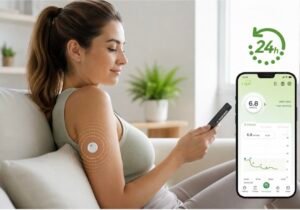
A regular glucose monitor measures glucose in a drop of blood obtained by a finger prick. A sugar monitor without routine finger pricks works differently: a thin flexible filament is inserted under the skin, which measures glucose in the interstitial fluid. Therefore, routine finger pricks are no longer needed daily — you see the readings in the phone app. Such a glucose sensor you apply it once and wear it for up to 15 days. It is a minimally invasive device: inserting the sensor takes a second, and the sensor itself is small and water-resistant (IP68).

How it works
The filament continuously measures the glucose concentration in the interstitial fluid and transmits the data to your phone. According to the manufacturer (MicroTech Medical), the system performs about 1440 measurements per day, so instead of a few numbers, you get a full daily picture. The app shows not only the current value but also trend arrows — whether your sugar is rising or falling — and warns you when glucose changes too quickly. This data accumulates, making it convenient to show a weekly or monthly curve to your doctor during your next visit.
How it differs from a standard glucose monitor
The main difference is the measurement method and the amount of information. A glucose monitor shows a single value at the moment you take a drop of blood with a prick. A continuous sensor shows not only the value but also the direction and history, helping to notice glucose spikes that single measurements miss:
- Standard glucose monitor — a finger prick, a single number, measured only when you decide to.
- Glucose monitor without routine finger pricks — the sensor measures automatically around the clock, showing a curve and trends without routine finger pricks.
However, in case of doubt about the readings or before important decisions, it is worth verifying with a standard finger prick measurement — the sensor complements, rather than completely replaces, a control measurement.
What are the benefits and who is it for
Continuous glucose monitoring (CGM) is useful for various people, and it is most valued by those who need to see the full glucose picture rather than individual numbers:
- For people with diabetes who want to monitor glucose changes throughout the day more conveniently.
- For those who find daily finger pricking inconvenient or painful.
- For active people who want to see how sports, diet, and stress affect their sugar.
- For relatives who want to monitor readings remotely and react in time.
Before starting to use CGM, it is always worth consulting a doctor or pharmacist — they will help evaluate if the device suits your situation and explain how to interpret the readings correctly.
How much it costs and how to choose
The price of one sensor (15 days) starts from 39 €. When choosing a larger set, the price per day decreases, making it more economical for long-term users. When choosing a glucose monitor without routine finger pricks, pay attention to a few things: whether the sensor is compatible with your phone, how many days it can be worn, whether there is a Lithuanian app, and how convenient it is to purchase. You can start with a one-sensor set (15 days) and later switch to a larger one. If you want to compare individual systems, there is a useful review about continuous glucose monitoring (CGM) systems.
How to start using
Getting started is simple: clean and dry the skin, apply the sensor to the upper arm according to the instructions, activate it in the app, and wait for a short warm-up period. After that, the readings will appear on your phone automatically. Since the sensor is water-resistant, it does not need to be removed while washing or exercising. It is important to follow the manufacturer's instructions and not to change your treatment or insulin dose on your own — always consult your doctor about this.
Frequently asked questions
Does a glucose monitor without routine finger pricks hurt?
Inserting the sensor takes a second and is usually felt as a slight prick; the sensor is not felt while wearing it. There is no need for daily finger pricking. In case of doubt about the readings, measure glucose from the finger.
Is such a monitor accurate?
CGM sensors show glucose in the interstitial fluid, so the value may differ slightly from a blood test, especially during rapid changes. Specific accuracy indicators are provided by the manufacturer; in case of doubt, verify with a finger prick measurement.
Does the sensor replace a doctor?
No. The sensor helps monitor glucose changes, but it does not replace a consultation with a doctor or treatment. Treatment decisions are made by a doctor.
How long does one sensor last?
One sensor is worn for up to 15 days, after which it is replaced with a new one. The app reminds you when the replacement time is approaching.
Can it be bought without a prescription?
Continuous glucose monitoring (CGM) sensors can be purchased without a prescription. However, before starting to use them, it is worth consulting a doctor or pharmacist.
Medical device. Read the instructions for use before use. This information is for educational purposes only and does not replace a consultation with a doctor or pharmacist. Before changing your diabetes treatment or insulin dose, consult a healthcare professional. In case of doubt about the readings, measure glucose from the finger. Use the medical device according to the manufacturer's (MicroTech Medical) instructions. Individual results may vary.
About author

Related posts

Diabetes sensors are a continuous glucose monitoring (CGM) solution that allows you to see your sugar level in real time and react to its fluctuations immediately. In the article, we discuss how... Continue reading

Sugar spikes in the glucose curve appear unexpectedly — after a meal, stress, or sleep. This article explains what such fluctuations mean and why it is important to monitor them in real... Continue reading
How a glucose sensor works — a comprehensive educational article about CGM technology: interstitial fluid, subcutaneous filament, electrochemical measurement, and data transmission to a smartphone. Learn more,... Continue reading

Glucose sensor price in Lithuania — from 39 € for 15 days of monitoring. Find out how much one day with the LinX CGM sensor costs, what the price depends on... Continue reading

For decades, the glucose monitor was the main glucose measurement tool. Today, alongside it are continuous monitoring sensors showing real-time glucose changes without routine finger pricks. Read how... Continue reading