No products in the cart.
Return To Shop
Continuous glucose monitoring (CGM): what is the difference between LinX, Dexcom ONE+ and other CGM systems?
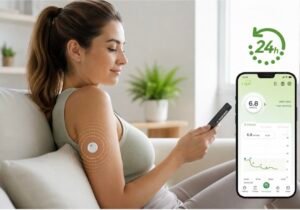
A continuous glucose sensor is a small device attached to the body with a patch, featuring an electrode inserted under the skin, which helps to continuously monitor glucose changes around the clock.
A glucose sensor is one of the parts of a continuous glucose monitoring (CGM) system. A CGM consists of a sensor, a transmitter, and a reader or a phone app.
CGM helps to see not only a single glucose number, but also the whole picture of its variation: when glucose rises, when it falls, how fast it happens, and what daily factors affect it. Therefore, CGM has become an important part of daily self-monitoring for many people with type 1 diabetes.
However, glucose sensors can also be very valuable for people with type 2 diabetes, prediabetes, or metabolic syndrome, as they help to see how specific meals, eating times, physical activity, medications, or sleep quality affect glucose.
In addition, glucose sensors are increasingly worn by people without diabetes. Although physiological fluctuations in glucose levels are a natural phenomenon, frequent, pronounced, or prolonged fluctuations can be a signal that it is worth taking a closer look at diet, physical activity, sleep, stress, and overall metabolic health. CGM helps to see what is really happening in the body and to change behavior in a healthier direction.
CGM choices
When choosing a CGM system, people are often interested in well-known solutions, such as Dexcom
ONE+, as well as newer alternatives, for example, LinX.
Both Dexcom ONE+ and LinX belong to the category of real-time glucose monitoring systems.
Both systems are designed to help better understand glucose changes in daily life, see trends and
receive alerts about too high or too low glucose levels.
When choosing a CGM system, it is worth paying attention to several practical criteria:
how many days the sensor works,
how often data is updated,
whether scanning is required,
what the alert options are,
whether data can be shared with loved ones,
whether the system is convenient for daily use.
People looking for a Dexcom ONE+ alternative usually evaluate not only the brand, but also
the sensor wear duration, data update frequency, price, alert options, and daily
use convenience. For example, the Dexcom ONE+ sensor works for up to 10 days with an additional 12
hour grace period and sends glucose data every 5 minutes. The LinX sensor works for up to 15 days, and glucose data in the app is updated every 1 minute.
It is important to understand that the "best" CGM system does not necessarily mean the same thing to everyone. For one person, the most important criterion might be a well-known brand or specific app features, for another – a longer sensor wear time, smaller size, price, or simpler daily use. Therefore, when choosing between Dexcom ONE+, LinX, or other CGM systems, it is worth evaluating not only the technical parameters but also your lifestyle, treatment plan, glucose monitoring goals, and the recommendations of a healthcare professional.
LinX – small but powerful
LinX stands out with its compact size, 15-day operating time, IP68 water resistance, real-time glucose data, the ability to monitor glucose curves on a smartphone, and an attractive price-to-functionality ratio. It is a convenient choice for people who want a clear, everyday glucose monitoring solution – both for diabetes control and for a better understanding of their metabolic health.
LinX is not just "another sensor". The MARD of 8.66% declared by the manufacturer indicates a high level of accuracy, and the measurement range from 2.0 to 25.0 mmol/l allows monitoring a wide spectrum of glucose changes, so LinX can be relevant for people with type 1 diabetes, type 2 diabetes, prediabetes, metabolic syndrome, and those who want to better understand their metabolism.
LinX also stands out for its extremely simple and intuitive use: it is enough to take the sensor applicator out of the box, place it against the skin, and press the button. Before use, it is important to read the manufacturer's instructions.
Dexcom ONE+, LinX or another CGM system – what to choose?
When choosing a continuous glucose monitoring system, it is important to look not only at the brand but also at how the system will fit into your daily routine. A glucose sensor should not be an additional worry, but a convenient helper that works quietly in the background and provides more clarity when it is needed most.
For people with type 1 diabetes, the most important things are often timely alerts about hypoglycemia and hyperglycemia, clearly visible glucose trends, and the ability to quickly make decisions regarding insulin, food, or physical activity. For people with type 2 diabetes, prediabetes, or metabolic syndrome, CGM can help to better understand how different meals, medications, movement, sleep, or stress affect glucose. And for people without diabetes, a glucose sensor can become a self-monitoring tool, helping to better understand their metabolism and notice which daily choices help them feel more stable.
Therefore, when comparing Dexcom ONE+, LinX, or other CGM systems, it is worth asking very practical questions:
Is a longer sensor operating time more important to me?
Do I want more frequent data updates?
Is the price important to me?
Do I want simple sensor insertion and startup?
Is it relevant to share data with loved ones?
Will the system be comfortable to wear while playing sports, traveling, sleeping, or working?
LinX can be an attractive choice for those looking for a small, lightweight, longer-lasting, and everyday-adapted glucose sensor. It provides the opportunity to see glucose changes in real time, notice recurring patterns, and better understand your body's reactions. Ultimately, the best CGM system is the one a person willingly uses every day – because only consistently collected data turns into real insights.
About author

Related posts

Diabetes sensors are a continuous glucose monitoring (CGM) solution that allows you to see your sugar level in real time and react to its fluctuations immediately. In the article, we discuss how... Continue reading

Sugar spikes in the glucose curve appear unexpectedly — after a meal, stress, or sleep. This article explains what such fluctuations mean and why it is important to monitor them in real... Continue reading
How a glucose sensor works — a comprehensive educational article about CGM technology: interstitial fluid, subcutaneous filament, electrochemical measurement, and data transmission to a smartphone. Learn more,... Continue reading

Glucose sensor price in Lithuania — from 39 € for 15 days of monitoring. Find out how much one day with the LinX CGM sensor costs, what the price depends on... Continue reading

For decades, the glucose monitor was the main glucose measurement tool. Today, alongside it are continuous monitoring sensors showing real-time glucose changes without routine finger pricks. Read how... Continue reading


Add comment