No products in the cart.
Return To Shop
Glucose monitor: how it works and when it is worth choosing a sensor
A glucose monitor is the first tool for many people that helped them understand what is happening with their blood sugar level. However, technology does not stand still: today, alongside the traditional glucose monitor, continuous monitoring sensors have emerged that measure glucose without routine finger pricks. If you want to know how these solutions differ and whether it is worth choosing glucose sensors as an additional tool, this article is exactly for you.
What is a glucose monitor and how does it work?
A glucose monitor is a small device that measures the glucose concentration in the blood. The measurement is performed simply: a finger is pricked with a special lancet, a drop of blood is placed on a disposable strip, and the device shows the result in a few seconds.
Traditional glucose monitors work on the principle of an electrochemical reaction. The enzyme on the strip (usually glucose oxidase) reacts with the glucose in the blood and generates an electrical signal, which the device converts into a numerical reading – millimoles per liter (mmol/l). All this happens in less than 10 seconds.
The device is reliable, inexpensive, and widely available. However, it only provides a snapshot – a value of one specific moment. To see how glucose changes while eating, exercising, or sleeping, you would need to measure very often.
When is a glucose monitor really useful?
A traditional glucose monitor perfectly meets many needs:
- Periodically checking glucose according to a doctor's recommendation.
- Verifying the readings of another measuring device – this is especially important when in doubt.
- In situations where a quick, one-time check is needed.
- When the budget is limited and there is no need for continuous monitoring.
However, routine finger pricks can become a routine that is tiring in the long run. Every finger prick means pain, diligence, and time consumption – especially for people who need to check their glucose several times a day.
The limitations of a glucose monitor: what does it not tell?
One of the biggest drawbacks of a traditional glucose monitor is that it does not show glucose dynamics. For example:
- Is glucose currently rising or falling?
- How did it change during the night?
- Exactly how much and how fast did it rise after a meal?
These questions remain unanswered if you only use a traditional device. This is exactly where the benefits of continuous glucose monitoring (CGM) sensors open up – they record the glucose level around the clock, showing not only the value but also the direction and change over time.
Continuous monitoring sensor – how does it differ?

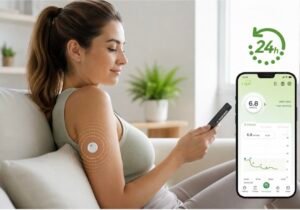
A CGM sensor is a minimally invasive solution: a thin filament is inserted directly under the skin (usually on the upper arm or abdomen) and measures glucose in the interstitial fluid continuously – up to 1,440 times a day (according to the manufacturer, MicroTech Medical). The readings are transmitted directly to a smartphone, so you can see the glucose curve in real time.
If you are looking for such a solution that can be tried without long-term commitments, check out a single sensor kit (15 days) – it is a great way to understand what continuous glucose monitoring (CGM) looks like.
The LinX CGM sensor (MicroTech Medical) meets EU medical device requirements (CE mark, Class IIb). It is water-resistant (IP68) and works for up to 15 days. All this allows you to monitor glucose while living actively – exercising, traveling, or just in everyday activities.
Glucose monitor and CGM sensor: are they alternatives?
It is important to understand: a CGM sensor does not replace a glucose monitor, but complements it. When measuring in the interstitial fluid rather than directly in the blood, a slight time difference between the readings of both devices may occur – this is normal and known in advance. Therefore, in case of doubt about the sensor reading (especially if you feel unwell or the readings are unexpected), it is always recommended to check glucose from the finger with a traditional tool.
A CGM sensor provides what a glucose monitor physically cannot – trend and dynamics. A glucose monitor provides what CGM requires to check – a direct blood measurement. Together, these tools work best.
Who is continuous monitoring best suited for?
Continuous glucose monitoring (CGM) sensors can be especially relevant for:
- People who want to understand how different foods affect their glucose.
- Those with diabetes.
- Active people who exercise regularly and want to track their body's response to physical exertion.
- Those for whom routine finger pricks are inconvenient or tiring.
- Those who want to monitor glucose changes during the night.
If you are hearing about such sensors for the first time and want to understand the broader context, you can check out glucose monitor without routine finger pricks and find out what options are available on the Lithuanian market.
Frequently asked questions
How does a glucose monitor differ from a CGM sensor?
A glucose monitor measures glucose in the blood at one specific moment, requiring a finger prick. A CGM sensor measures glucose in the interstitial fluid continuously – up to several hundred times a day – and transmits data to a phone in real time. This allows you to see glucose dynamics, not just a momentary value.
Is a CGM sensor as accurate as a glucose monitor?
CGM sensors, such as LinX, are highly accurate (according to the manufacturer, MicroTech Medical). However, they measure in the interstitial fluid, so there may be a slight time lag compared to a direct blood measurement. In case of doubt, it is always possible to check from the finger.
Is the LinX CGM sensor suitable for sports?
Yes. The LinX sensor has IP68 water protection, making it suitable for swimming, sports, or spending time actively outdoors. The sensor works for up to 15 days without additional maintenance.
How much does the LinX CGM sensor cost?
One sensor (for 15 days of use) costs from 39 €. Two sensors together cost 78 €. This is an affordable way to try continuous glucose monitoring (CGM) without large initial investments.
Does a CGM sensor replace a consultation with a doctor?
No. A CGM sensor is a monitoring tool that provides information about glucose changes. It does not replace a consultation with a doctor or specialist and should not be used as a basis for diagnosis or treatment. Coordinate all health decisions with your doctor.
Medical device. Read the instructions for use before use. This information is for educational purposes only and does not replace a consultation with a doctor or pharmacist. In case of doubt about the readings, measure glucose from the finger. Individual results may vary.
About author

Related posts

Diabetes sensors are a continuous glucose monitoring (CGM) solution that allows you to see your sugar level in real time and react to its fluctuations immediately. In the article, we discuss how... Continue reading

Sugar spikes in the glucose curve appear unexpectedly — after a meal, stress, or sleep. This article explains what such fluctuations mean and why it is important to monitor them in real... Continue reading
How a glucose sensor works — a comprehensive educational article about CGM technology: interstitial fluid, subcutaneous filament, electrochemical measurement, and data transmission to a smartphone. Learn more,... Continue reading

Glucose sensor price in Lithuania — from 39 € for 15 days of monitoring. Find out how much one day with the LinX CGM sensor costs, what the price depends on... Continue reading

Does an Omron non-invasive glucose monitor exist? We debunk this popular myth and explain why such a device does not yet meet medical accuracy standards — and what minimally invasive... Continue reading