No products in the cart.
Return To Shop
Omron non-invasive glucose monitor: does one really exist?
Search engines increasingly show the query "omron non-invasive glucose monitor” — people are looking for a device that measures glucose completely without any contact with the skin or tissues. In this article, we will examine whether such an Omron product actually exists, why this idea still misleads consumers, and what are currently realistically available glucose sensors, allowing to monitor sugar without routine finger pricks.
Myth: Omron has produced a working non-invasive glucose monitor
The Japanese company Omron is well known for blood pressure monitors and other home medical devices. So it is not surprising that rumors are spreading online about an alleged "Omron non-invasive glucose monitor”, which supposedly measures sugar without any skin-piercing element. Unfortunately, this is a myth. Currently, Omron has not released any clinically tested non-invasive glucose monitor approved by the EU or other recognized regulatory authorities that can be purchased and safely used at home.
Certain Omron concepts and prototypes have been presented at technology exhibitions, but they remained laboratory experiments. There is a huge gap between a stage demonstration and a clinically reliable medical device, which science has not yet been able to fill.
Why does true non-invasive glucose measurement still not exist?

Gliukozė kraujyje matuojama remiantis jos koncentracija tarpląsteliniame skystyje arba tiesiogiai kraujyje. Visos šiuo metu mokslo bendruomenės pripažintos technologijos — tiek tradiciniai gliukometrai, tiek modernūs nuolatinio stebėjimo prietaisai — reikalauja tiesioginio sąlyčio su kūno skysčiais. Priežastys, kodėl visiškai kontaktinio elemento neturintis matavimas nesukuriamas:
- Skin layers, fat, and other tissues strongly distort the optical or electromagnetic signal.
- The concentration of glucose molecules is very low, making it extremely difficult to isolate it from many other substances through the skin.
- Every person's skin thickness, pigmentation, and hydration differ — this increases the measurement error to a clinically unacceptable level.
- So far, no such device has received the CE mark under the EU medical device requirements as a medical glucose monitor.
In short: promotional videos on social networks about a "laser on the wrist” or "contactless sugar measurement” are either commercial scams or technologies that do not work with clinically significant accuracy.
What is actually offered to the market: CGM sensors without routine finger pricks
Although completely non-invasive measurement remains in the realm of science fiction, modern medicine has offered another clinically reliable and approved solution — continuous glucose monitoring (CGM) systems. They work on the principle: a thin filament is inserted under the skin (only once, for up to 15 days) and continues to measure glucose in the interstitial fluid without routine finger pricks. This is a minimally invasive method that allows you to live a normal life.
If you are looking for a glucose monitor without routine finger pricks, CGM sensors today are the closest realistic answer to this need.
LinX CGM: a minimally invasive sensor without routine finger pricks
LinX CGM, manufactured by MicroTech Medical, is one of the modern continuous monitoring solutions available in Lithuania. Here is what distinguishes it from traditional glucose monitors:
- A thin filament is inserted under the skin once — it works for up to 15 days without routine finger pricks.
- Measures about 1,440 times a day (according to the manufacturer MicroTech Medical), readings are available in real time on a smartphone.
- IP68 water protection — you can exercise, swim, and live normally.
- Has a CE mark according to the EU medical device requirements (Class IIb) — this means the device meets strict European safety standards.
- High accuracy (according to the manufacturer MicroTech Medical), comparable to other CGM solutions on the market.
Of course, LinX does not replace a traditional glucose monitor — it complements it. In case of doubt about the readings, it is recommended to measure blood glucose from the finger and consult a doctor.
How not to fall into the trap of misleading devices?
Before buying any glucose measuring device, it is worth paying attention to a few things:
- Check if the device has a CE mark as a medical glucose monitor (not just as a "wellness device”).
- Look for independent clinical trials confirming accuracy — not just the manufacturer's promotional claims.
- Be careful with devices that promise to measure glucose through the wrist, finger, or ear without any skin element — there are no such reliable medical devices on the market today.
- Consult with your doctor or diabetologist about which monitoring system is best for you.
You can review a single sensor kit (15 days) and evaluate whether LinX CGM suits your lifestyle.
Omron and other manufacturers: where is science heading?
Omron and other large companies (Samsung, Apple, Google) are investing in glucose measurement research. In the future, technologies may emerge that would allow more accurate glucose measurement through the skin. However, today these projects are in the research stage — none have entered the market as a clinically approved medical device. So if you see an advertisement with "Omron non-invasive glucose monitor — buy”, act carefully and look for the official CE mark.
Meanwhile, CGM technology already offers a real solution — a minimally invasive, convenient, and clinically supported way to monitor glucose without routine finger pricks.
Frequently asked questions
Does Omron really have a non-invasive glucose monitor?
No. Currently, Omron has not released any clinically approved, CE-marked non-invasive glucose monitor to the general market. Claims spreading online are mostly based on concepts or prototypes that do not meet the requirements of a medical device.
Ar egzistuoja koks nors visiškai kontakto nereikalaujantis gliukozės matuoklis?
Currently, there is no CE-marked device (as a medical glucose monitor) on the market that measures glucose completely without skin contact or tissue interaction. Such technology does not yet meet clinically significant accuracy standards.
What is the difference between a CGM sensor and a traditional glucose meter?
A traditional glucose meter requires daily finger pricking to take a drop of blood. A CGM sensor — for example, LinX — uses a thin filament inserted once under the skin, and measures glucose in the interstitial fluid automatically for up to 15 days without routine finger pricks.
Is the LinX CGM suitable for diabetics?
The LinX CGM is a CE-marked medical device (Class IIb). However, anyone with diabetes or other health conditions should consult their doctor before changing their monitoring method. The device complements, but does not replace a consultation with a doctor or a traditional glucose meter.
How much does the LinX CGM sensor cost in Lithuania?
A one-sensor kit (15 days) costs from 39 €, a two-sensor pack — 78 €. They can be purchased in the gliukozesmatuoklis.lt store.
Medical device. Read the instructions for use before use. This information is for educational purposes only and does not replace a consultation with a doctor or pharmacist. In case of doubt about the readings, measure glucose from the finger. Individual results may vary.
About author

Related posts

Diabetes sensors are a continuous glucose monitoring (CGM) solution that allows you to see your sugar level in real time and react to its fluctuations immediately. In the article, we discuss how... Continue reading

Sugar spikes in the glucose curve appear unexpectedly — after a meal, stress, or sleep. This article explains what such fluctuations mean and why it is important to monitor them in real... Continue reading
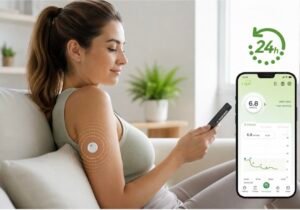
How a glucose sensor works — a comprehensive educational article about CGM technology: interstitial fluid, subcutaneous filament, electrochemical measurement, and data transmission to a smartphone. Learn more,... Continue reading

Glucose sensor price in Lithuania — from 39 € for 15 days of monitoring. Find out how much one day with the LinX CGM sensor costs, what the price depends on... Continue reading

For decades, the glucose monitor was the main glucose measurement tool. Today, alongside it are continuous monitoring sensors showing real-time glucose changes without routine finger pricks. Read how... Continue reading