No products in the cart.
Return To Shop
Glucometer or sensor: what is the difference and which to choose
A glucometer is the first tool for many people to check their blood glucose level. However, alongside traditional solutions, you can now also choose glucose sensors , which measure without routine finger pricks. In this article, we honestly and without disparagement compare both options — so you can decide which suits your daily routine.
What is a glucometer and how does it work?

A glucometer (also called a glucose monitor) is a small handheld device that measures the glucose level in capillary blood. The procedure is familiar to many: a finger is pricked with a special lancing device, a drop of blood is placed on a test strip, and the device shows the reading in a few seconds.
Glucometers work on the principle of electrochemical measurement — an enzyme in the test strip reacts with glucose and generates a weak electrical signal, which the device converts into a number on the screen. This is a proven technology used for decades.
Glucometers are easily accessible in pharmacies, relatively cheap to buy, and their readings usually meet clinical standards. The main reason why they cause fatigue for some people is the daily routine of pricking, especially when it is necessary to measure several times a day.
What is a CGM sensor and how does it work?
A continuous glucose monitoring (CGM) sensor is a modern medical device that measures glucose not in the blood, but in the interstitial fluid — under the skin. A sensor like LinX has a thin filament that is inserted directly under the skin and reads data about every minute, i.e., up to 1,440 times a day.
Data is transmitted in real time to a smartphone — you see not only the current value, but also the glucose curve over the past hours: whether it is rising, falling, or remaining stable. This is qualitatively new information that a glucometer simply cannot provide — it only shows a "snapshot” of a single moment, while CGM shows the whole "movie”.
The LinX sensor meets EU medical device requirements (CE mark, Class IIb) and works for up to 15 days. You can buy it a single sensor kit (15 days) from 39 €.
Main differences: glucometer and CGM sensor
- Measurement frequency: glucometer — only by pricking a finger; CGM sensor — up to 1,440 times a day automatically.
- Measurement location: glucometer reads capillary blood; CGM sensor filament measures interstitial fluid under the skin.
- Finger pricking: glucometer requires a finger prick every time; LinX CGM sensor — without routine finger pricks.
- Data view: glucometer shows a single moment number; CGM shows a curve, trend and history.
- Duration of use: glucometer is used without an expiration date (only strips are changed); LinX sensor — up to 15 days, then replaced.
- Price: glucometer is cheaper as an initial purchase, but test strips accumulate over months; LinX CGM has a clear monthly price.
- Connection to phone: most glucometers — only a screen reading; CGM data is shown in the app in real time.
When does a glucometer remain a good choice?
The glucometer is not going anywhere and has its own advantages. It is suitable when:
- A one-time check is needed, not continuous monitoring.
- The budget is limited and the pricking frequency is low (e.g., 1–2 times a day).
- You want to additionally check the CGM sensor reading in case of doubt.
- A doctor recommends specifically capillary blood measurement in a specific case.
Important to know: a CGM sensor does not replace a consultation with a doctor and, in case of doubt about the readings, it is recommended to additionally measure glucose from the finger. Both devices can complement each other.
When does a CGM sensor provide more?
A CGM sensor provides real value for those who need to see glucose dynamics throughout the day — not just a single moment indicator. It is especially relevant for:
- People who want to understand how food, physical activity, or sleep affects glucose.
- Those who would like to avoid daily routine finger pricks, but still have continuous control.
- Active people, those who play sports or travel a lot — data is accessible on the phone at any time.
- Those whose doctor advises to monitor glucose fluctuations more actively.
Want to try continuous monitoring without routine finger pricks every day? Check out glucose monitor without routine finger pricks and find a solution that fits your rhythm.
Accuracy: what do the manufacturers say?
Glucose monitors measure capillary blood and have well-documented accuracy — it is a standardized, widely clinically tested technology. CGM sensors measure interstitial fluid, so readings may differ slightly from capillary blood, especially when glucose is changing rapidly. According to the manufacturer (MicroTech Medical), LinX features high accuracy under daily use conditions, but a doctor or pharmacist can help evaluate which technology is most suitable for your situation.
The accuracy of both technologies also depends on proper use: for a glucose monitor — on the right strip, clean hands, and proper pricking technique; for a CGM sensor — on proper insertion, sensor location, and body characteristics.
Frequently asked questions
Are a glucose meter and a glucose monitor the same thing?
Yes, these are different names for the same device in the Lithuanian language. A glucose meter, glucose monitor, or sugar monitor — all these words mean a handheld device that measures glucose from a drop of blood.
Does a CGM sensor completely replace a glucose monitor?
No, a CGM sensor complements, but does not replace a glucose monitor in all situations. In case of doubt about CGM readings, it is recommended to check glucose from the finger. Make a decision regarding the usage routine after consulting with a doctor.
How much does the LinX CGM sensor cost?
A set of one LinX CGM sensor (for 15 days of use) costs from 39 €, a pack of two sensors — 78 €. This amounts to about 2.6 € per day for continuous monitoring without routine finger pricks.
Can a CGM sensor be used while playing sports or bathing?
The LinX CGM sensor has IP68 water protection, making it suitable for an active lifestyle — playing sports, swimming, or bathing. Always read the instructions for use for specific usage recommendations.
Do you need a doctor's prescription to purchase a CGM sensor?
LinX CGM sensors can be purchased without a prescription. However, if you are monitoring glucose due to a diagnosed disease or are using insulin, consult your doctor before changing your monitoring method.
Medical device. Read the instructions for use before use. This information is for educational purposes only and does not replace a consultation with a doctor or pharmacist. In case of doubt about the readings, measure glucose from the finger. Individual results may vary.
About author

Related posts

Diabetes sensors are a continuous glucose monitoring (CGM) solution that allows you to see your sugar level in real time and react to its fluctuations immediately. In the article, we discuss how... Continue reading

Sugar spikes in the glucose curve appear unexpectedly — after a meal, stress, or sleep. This article explains what such fluctuations mean and why it is important to monitor them in real... Continue reading
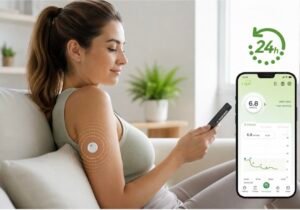
How a glucose sensor works — a comprehensive educational article about CGM technology: interstitial fluid, subcutaneous filament, electrochemical measurement, and data transmission to a smartphone. Learn more,... Continue reading

Glucose sensor price in Lithuania — from 39 € for 15 days of monitoring. Find out how much one day with the LinX CGM sensor costs, what the price depends on... Continue reading

For decades, the glucose monitor was the main glucose measurement tool. Today, alongside it are continuous monitoring sensors showing real-time glucose changes without routine finger pricks. Read how... Continue reading