No products in the cart.
Return To Shop
Automatic glucose monitor: how continuous monitoring works
An automatic glucose monitor changes how people monitor glucose in their daily lives — instead of single measurements by pricking a finger, modern glucose sensors record readings continuously, without interruptions. If you are looking for a solution that allows you to see glucose changes in real time — day, night, while exercising or traveling — this article will help you understand how continuous monitoring works, how it differs from manual measurement, and why monitoring trends is no less important than individual numbers.
What is an automatic glucose monitor?
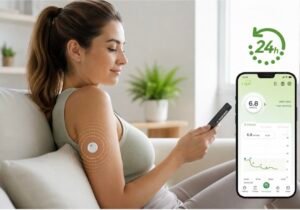
An automatic glucose monitor is a continuous glucose monitoring (CGM) system that measures the glucose level in the interstitial fluid automatically and regularly, without any additional action on your part. There is no need to take a drop of blood every time — a thin filament inserted under the skin (usually on the upper arm) continuously monitors glucose and sends the data directly to your smartphone.
The LinX CGM sensor, which you can find in the gliukozesmatuoklis.lt store, works on this principle: one discreet sensor on the upper arm, up to 15 days of use, up to 1440 measurements per day (according to the manufacturer MicroTech Medical) — which means approximately one measurement every minute. The system meets EU medical device requirements (Class IIb, CE mark).
Automatic vs manual measurement: what are the differences?

A traditional glucometer is a manual device: to find out the glucose level, you need to prick your finger, take a drop of blood and wait for the result. It works — but this way you only get a momentary reading, not the full picture. Between two measurements, glucose can rise or fall significantly, and you won't even notice it.
An automatic glucose monitor solves this problem fundamentally. Here are the main differences:
- Manual measurement provides 1 data point at a time; CGM — hundreds per day.
- With the manual method, you need to prick your finger every time; a CGM sensor is inserted once and works for up to 15 days without routine finger pricks.
- Manual measurement does not show whether glucose is rising or falling right now — CGM shows trends in real time.
- Nighttime changes are almost unrecorded with a manual monitor; CGM monitors around the clock, including while sleeping.
- Data graphs and trends with CGM can be viewed in the app in seconds.
It is important to mention: CGM does not replace a traditional glucose meter, but supplements it — especially in cases where there are doubts about the accuracy of the readings or confirmation is needed before important decisions.
Why are trends more important than a single number?
One of the biggest advantages of an automatic glucose monitor is the ability to show not only the current glucose level, but also the direction in which it is moving. Glucose may be within the normal range, but drop rapidly after a while — this is important information that manual measurements simply do not provide.
Monitoring trends allows you to:
- Notice how specific food affects glucose after 30, 60 or 90 minutes.
- Understand whether physical activity lowers or raises the glucose level in your case.
- Identify when glucose fluctuates the most — even at night.
- Compare different days and look for recurring patterns.
This data can be extremely useful in a conversation with a doctor — not as a basis for diagnosis, but as additional information when monitoring health.
How does the alert system work?
An automatic glucose monitor with smart app support can send alerts when the glucose level goes out of the set limits. In the LinX CGM system, readings are transmitted to the phone via Bluetooth — this means that the app can warn you about both too high and too low glucose, even if you are not looking at your phone at the time.
This is especially important at night: glucose can change while sleeping, and without automatic monitoring, these changes often go unnoticed until morning. Alerts on the phone are an additional layer of security that manual measurement simply cannot provide.
Want to try such monitoring without a big financial risk? You can start with a one-sensor set (15 days) — it is a great way to evaluate how continuous monitoring works in your daily life.
Who is an automatic glucose monitor best suited for?
CGM technology was created primarily for people who need to monitor glucose frequently and systematically. However, today it is increasingly chosen by those who want to better understand their body — whether they are athletes wanting to optimize nutrition and recovery, or simply people caring about their health and energy levels.
The LinX CGM sensor is suitable for:
- Those whose doctor recommends frequent glucose monitoring.
- Active people who want to understand how physical exertion affects glucose.
- Those who want to give up routine finger pricks and get more data.
- People who want to review long-term trends and discuss them with their doctor.
If you are looking for a more convenient way to monitor glucose, check out glucose monitor without routine finger pricks — it is a modern solution that fits into daily life without changing your habits.
How much does it cost and how to start?
The LinX CGM sensor in the gliukozesmatuoklis.lt shop costs from 39 € for one sensor (for 15 days of use). Two sensors — 78 €, which means 30 days of continuous monitoring. The sensor is water-resistant (IP68), so it is suitable for sports, bathing or outdoors on a rainy day. Connection to a smartphone is via Bluetooth, without additional devices.
Getting started is simple: the sensor is attached to the upper arm (this is done by the user themselves or with the help of a loved one), the app is connected via the phone and within a few minutes the readings are already visible on the screen. The first data is available quickly, and a full picture of trends is formed within the first few hours.
Frequently asked questions
Is an automatic glucose monitor accurate?
According to the manufacturer (MicroTech Medical), LinX CGM features high accuracy. However, it is important to know that a CGM sensor measures glucose in the interstitial fluid, not directly in the blood — therefore, there may be slight differences between the readings of a CGM and a traditional glucose meter, especially during a rapid change in glucose. If in doubt about the readings, it is always recommended to check glucose from the finger.
Do you need to prick your finger when using CGM?
When using LinX CGM for systematic monitoring, routine finger pricks are not required. However, doctors or the instructions for use may recommend traditional measurement from the finger in certain cases — for example, when readings seem unexpected or before important health decisions.
How long does one sensor last?
One LinX CGM sensor works for up to 15 days. During that time, according to the manufacturer, up to 1440 measurements per day are performed — this provides a comprehensive picture of glucose fluctuations over the entire period.
Is the CGM sensor suitable for sports or bathing?
Yes. The LinX CGM sensor has IP68 water protection, so it is suitable for use during sports, bathing in the shower or pool, and performing daily physical activities. The sensor is attached to the upper arm and is discreet — the vast majority of people do not even feel it while wearing it during daily activities.
Does an automatic glucose monitor replace a doctor?
No. A CGM sensor is a monitoring tool that provides additional information about glucose changes — it does not replace a consultation with a doctor, diagnosis or treatment. It is useful to discuss the collected data with a healthcare professional who can help interpret them correctly.
Medical device. Read the instructions for use before use. This information is for educational purposes only and does not replace a consultation with a doctor or pharmacist. In case of doubt about the readings, measure glucose from the finger. Individual results may vary.
About author

Related posts

Diabetes sensors are a continuous glucose monitoring (CGM) solution that allows you to see your sugar level in real time and react to its fluctuations immediately. In the article, we discuss how... Continue reading

Sugar spikes in the glucose curve appear unexpectedly — after a meal, stress, or sleep. This article explains what such fluctuations mean and why it is important to monitor them in real... Continue reading
How a glucose sensor works — a comprehensive educational article about CGM technology: interstitial fluid, subcutaneous filament, electrochemical measurement, and data transmission to a smartphone. Learn more,... Continue reading

Glucose sensor price in Lithuania — from 39 € for 15 days of monitoring. Find out how much one day with the LinX CGM sensor costs, what the price depends on... Continue reading

For decades, the glucose monitor was the main glucose measurement tool. Today, alongside it are continuous monitoring sensors showing real-time glucose changes without routine finger pricks. Read how... Continue reading