No products in the cart.
Return To Shop
Dexcom alternative in Lithuania: a cheaper continuous glucose monitor
A Dexcom alternative is of interest to an increasing number of people with diabetes in Lithuania who want to continuously monitor glucose changes but are looking for a more affordable price. Continuous glucose monitoring (CGM) systems show how sugar levels change around the clock and send that information directly to a phone. One of the more affordable options on the market is LinX CGM – a sensor that allows measuring glucose without routine finger pricks. In this article, we explain when it is worth looking for an alternative, how LinX differs from Dexcom, and how to switch to another system.
What is a CGM alternative to the Dexcom system

Dexcom is one of the best-known continuous glucose monitoring systems in the world. However, it is not the only one – there are others on the market glucose sensors manufacturing companies that offer a similar principle for a different price. A CGM alternative means a sensor that performs the same main function: it measures glucose in the interstitial fluid and transmits the readings to an app on the phone.
LinX CGM, manufactured by MicroTech Medical, works on the same principle. It is a minimally invasive device – a thin filament is inserted under the skin and remains there for the entire duration of use. According to the manufacturer, one sensor works for up to 15 days and performs about 1440 measurements per day.
Why people are looking for a Dexcom alternative in Lithuania
There are several reasons to look for another system. Most often they are related to price, availability, and ease of use. The main reasons why users consider an alternative:
- Price. Branded CGM systems can cost quite a bit in the long run, especially if sensors need to be replaced frequently.
- Prescription requirement. Some systems in Lithuania can only be purchased with a doctor's prescription, which slows down the process.
- Reimbursement limitations. Not all individuals meet the conditions for state reimbursement, so they buy the device themselves.
- Desire to avoid finger pricks. Many want to monitor glucose daily more conveniently, without routine finger pricks.
It is precisely for these reasons that a more accessible glucose monitor without routine finger pricks becomes a real choice for those looking for a simpler solution for daily self-monitoring.
LinX CGM advantages: price, convenience and availability
LinX stands out in several aspects that are important to people looking for a more affordable continuous glucose monitoring system. Main advantages:
- Price from 39 € for a one-sensor set (15 days), while a two-sensor set costs 78 €.
- Measurement without routine finger pricks – readings are accessible on the phone, without routine finger pricks for daily control.
- Available without a prescription, so the device can be ordered online and you can start using it faster.
- IP68 water resistance – according to the manufacturer, the sensor can be worn while bathing or exercising.
- Up to 15 days of continuous operation, so the sensor needs to be changed less frequently than some shorter-acting systems.
For those wanting to try the system, the most suitable starting option is a single sensor kit (15 days), which can be ordered to get familiar with the principle of continuous monitoring before buying a larger quantity.
How LinX differs from Dexcom
Both systems belong to the same continuous glucose monitoring (CGM) category, so the main operating principle is similar – the sensor measures glucose under the skin and sends data to the app. The differences are mainly related to price, purchasing procedure, and manufacturer. LinX is manufactured by MicroTech Medical, and the readings are displayed in its phone app.
When choosing between systems, it is worth paying attention to a few factual things: sensor lifespan, price per kit, whether a prescription is required, and whether the system is reimbursed. In the case of LinX, one sensor lasts up to 15 days, the price starts from 39 €, and no prescription is required. Specific Dexcom features and prices should be checked with the official representatives of the manufacturer, as they depend on the model and country. A broader comparison of the systems can be found in the article about how LinX, Dexcom, and other CGM systems differ.
How to switch to LinX
Switching to another continuous glucose monitoring (CGM) system is simple, but it is useful to discuss it with your doctor, especially if you adjust your treatment based on the readings. Simple steps:
- Check if your phone is compatible with the manufacturer's app and install it.
- Order a sensor kit online – for a start, one sensor is enough for a 15-day period.
- Apply the sensor according to the instructions and let it adjust for the time specified by the manufacturer.
- Monitor glucose changes in the app and, in case of doubt, check the readings by measuring from the finger.
It is important to remember that a CGM system does not replace a consultation with a doctor or a classic glucose monitor, but it helps people with diabetes better see glucose trends around the clock.
Frequently asked questions
Is LinX a suitable Dexcom alternative?
LinX belongs to the same continuous glucose monitoring (CGM) category and performs the same main function – it measures glucose under the skin and shows readings on the phone. Which system is suitable for a specific person is best discussed with a doctor.
How much does LinX CGM cost?
A one-sensor kit (15 days) costs from 39 €, and a two-sensor kit – 78 €. The price may vary depending on the selected kit.
Does LinX measure glucose without routine finger pricks?
Yes, for daily control, readings are accessible on the phone without routine finger pricks. The sensor itself is minimally invasive – a thin filament is inserted under the skin and remains for up to 15 days.
Can LinX be purchased without a prescription in Lithuania?
Yes, LinX CGM can be ordered without a prescription. However, if you adjust your treatment based on glucose readings, it is worth consulting a doctor.
How long does one sensor last?
According to the manufacturer (MicroTech Medical), one sensor lasts up to 15 days and performs about 1440 measurements per day.
Medical device. Read the instructions for use before use. This information is for educational purposes only and does not replace a consultation with a doctor or pharmacist. In case of doubt about the readings, measure glucose from the finger. Individual results may vary.
About author

Related posts

Diabetes sensors are a continuous glucose monitoring (CGM) solution that allows you to see your sugar level in real time and react to its fluctuations immediately. In the article, we discuss how... Continue reading

Sugar spikes in the glucose curve appear unexpectedly — after a meal, stress, or sleep. This article explains what such fluctuations mean and why it is important to monitor them in real... Continue reading
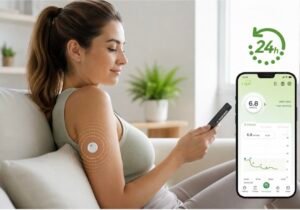
How a glucose sensor works — a comprehensive educational article about CGM technology: interstitial fluid, subcutaneous filament, electrochemical measurement, and data transmission to a smartphone. Learn more,... Continue reading

Glucose sensor price in Lithuania — from 39 € for 15 days of monitoring. Find out how much one day with the LinX CGM sensor costs, what the price depends on... Continue reading

For decades, the glucose monitor was the main glucose measurement tool. Today, alongside it are continuous monitoring sensors showing real-time glucose changes without routine finger pricks. Read how... Continue reading